

Citations
1. Poster announcing Benfica House of Toronto v. Croatia S.C. Zagreb soccer match at the CNE Stadium, Toronto. May 6, 1973. David Higgs fonds, 2010-018/004 (1), Clara Thomas Archives and Special Collections (CTASC), York University Libraries.
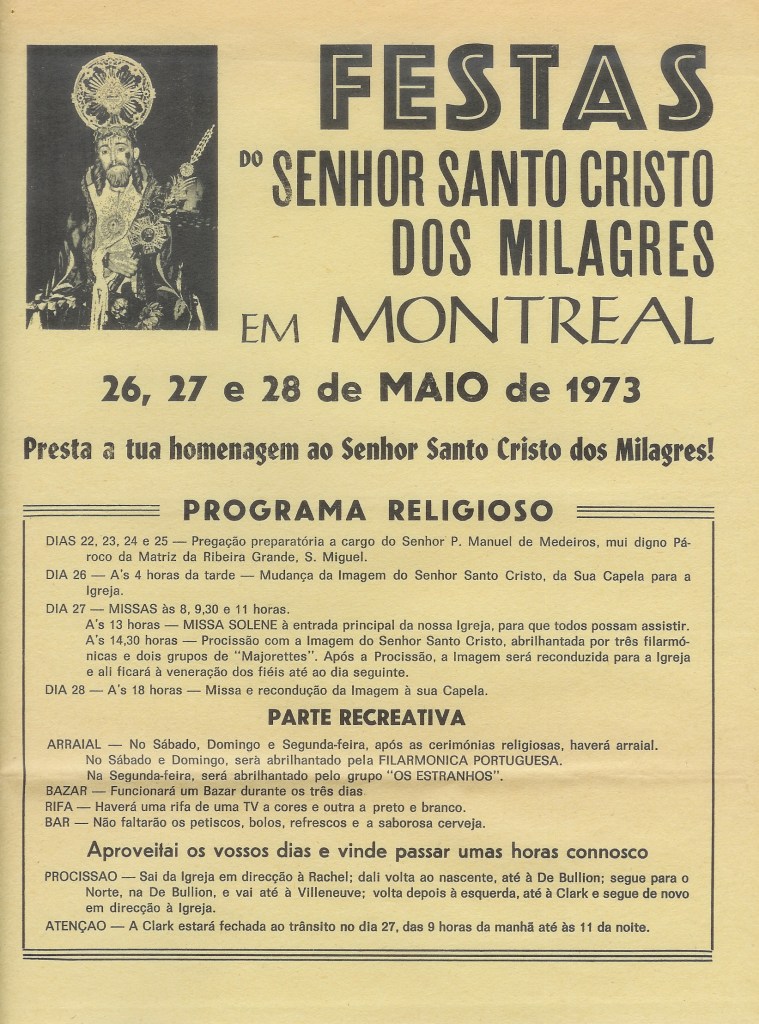
2. Poster announcing Holy Christ of Miracles (Senhor Santo Cristo dos Milagres) procession and festivities in Montreal. May 26-18, 1973. David Higgs fonds, 2010-018/004 (1), CTASC.
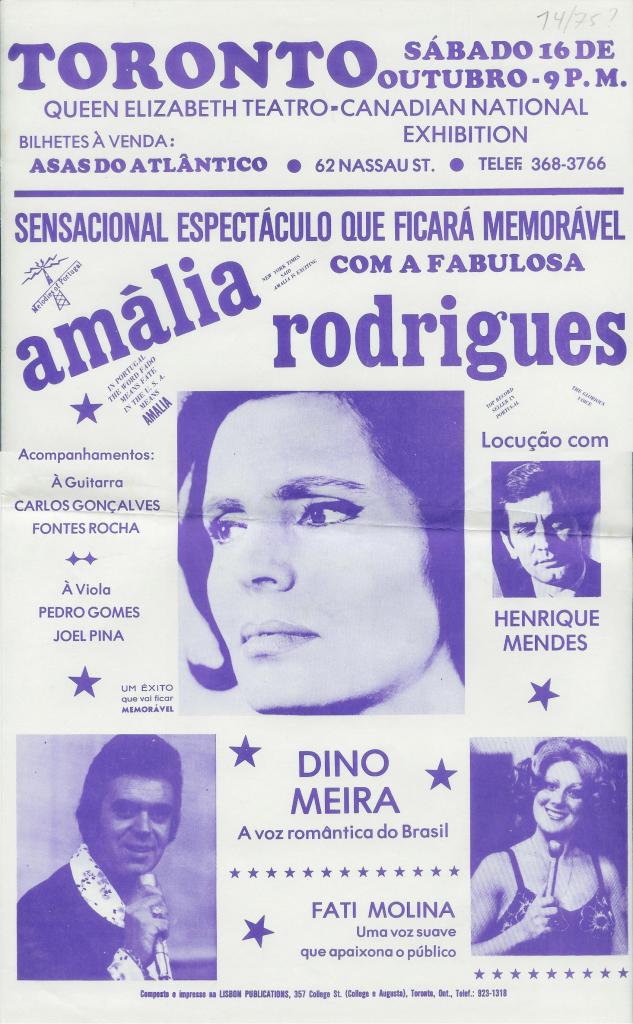
3. Poster announcing concerts by Portuguese singers Amália Rodrigues, Dino Meira, and Fati Molina, hosted by Henrique Mendes, at the CNE’s Queen Elizabeth Theatre, October 9, 1974(?). David Higgs fonds, 2010-018/004 (1), CTASC.
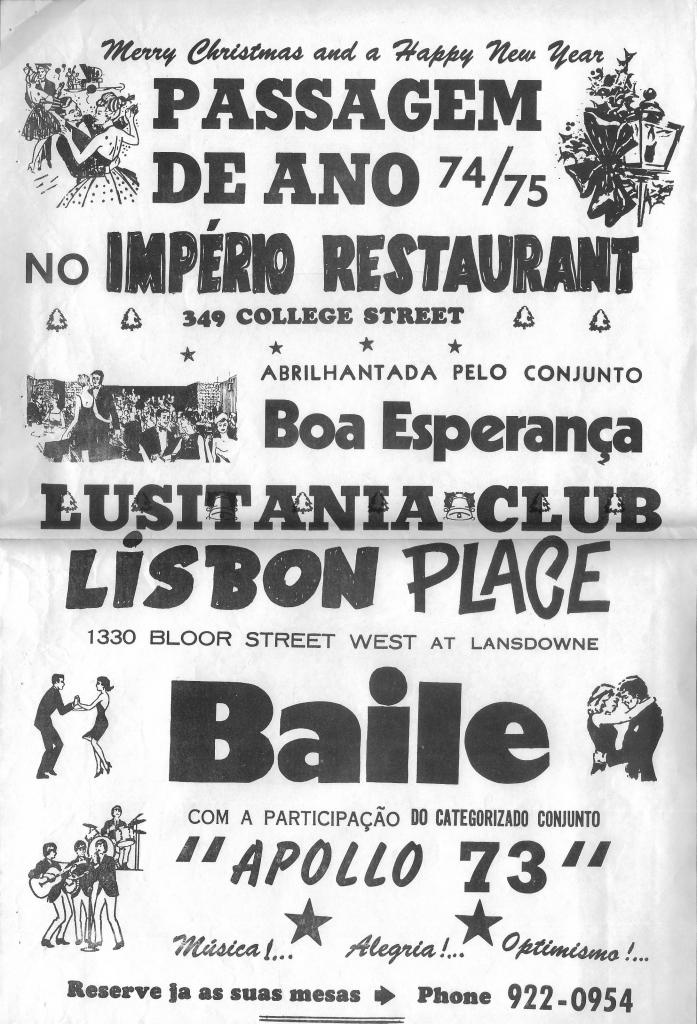
4. Poster announcing New Year’s party at Império Restaurant on 349 College St. and dance at the Lusitania Club Lisbon Place on 1330 Bloor St. West, Toronto, 1974-1975. David Higgs fonds, 2010-018/004 (1), CTASC.
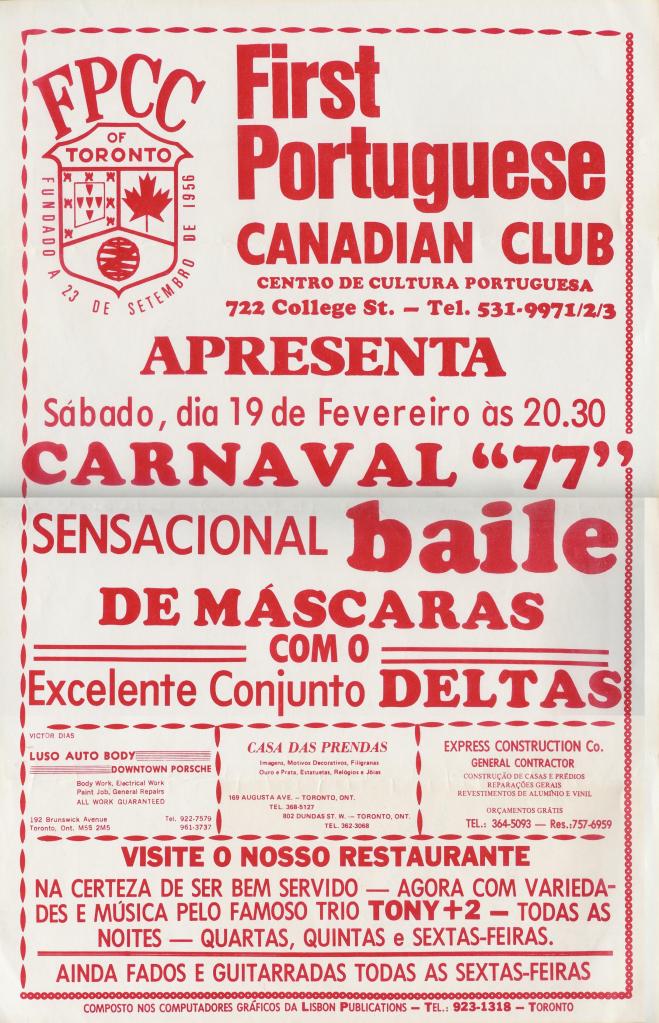
5. Poster announcing Carnaval (Mardi Gras) masquerade ball at the First Portuguese Canadian Club on 722 College Street, Toronto, February 19, 1977. David Higgs fonds, 2010-018/004 (1), CTASC.
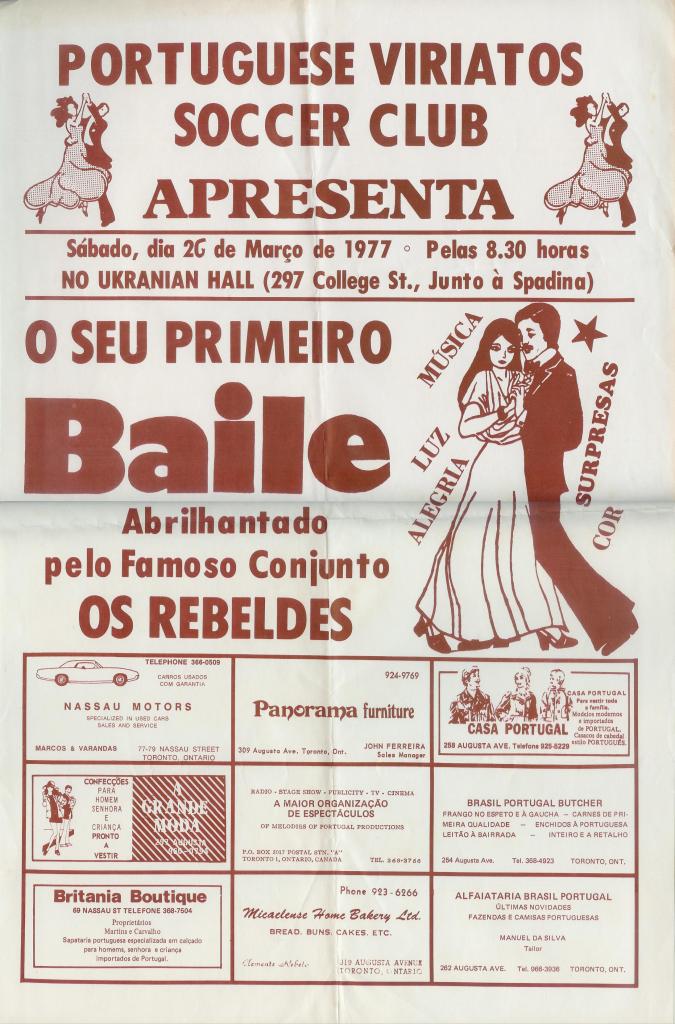
6. Poster announcing dance at the Portuguese Viriatos Soccer Club at the Ukrainian Hall, March 26, 1977. David Higgs fonds, 2010-018/004 (1), CTASC.
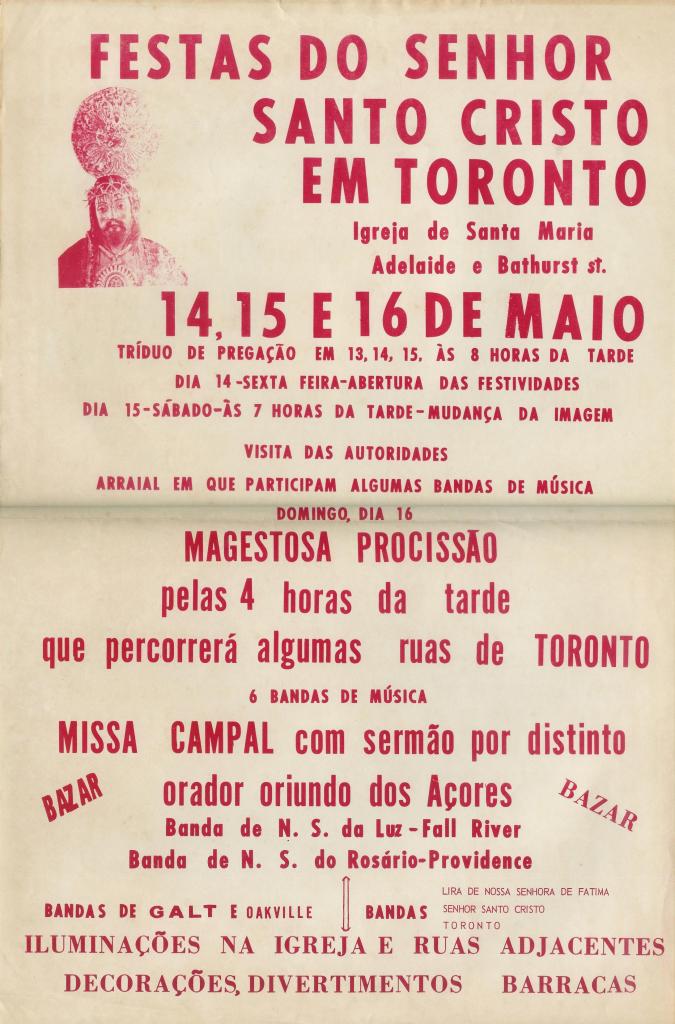
7. Poster announcing Holy Christ of Miracles (Senhor Santo Cristo dos Milagres) procession and festivities in Toronto. May 14-16, 197?. David Higgs fonds, 2010-018/004 (1), CTASC.
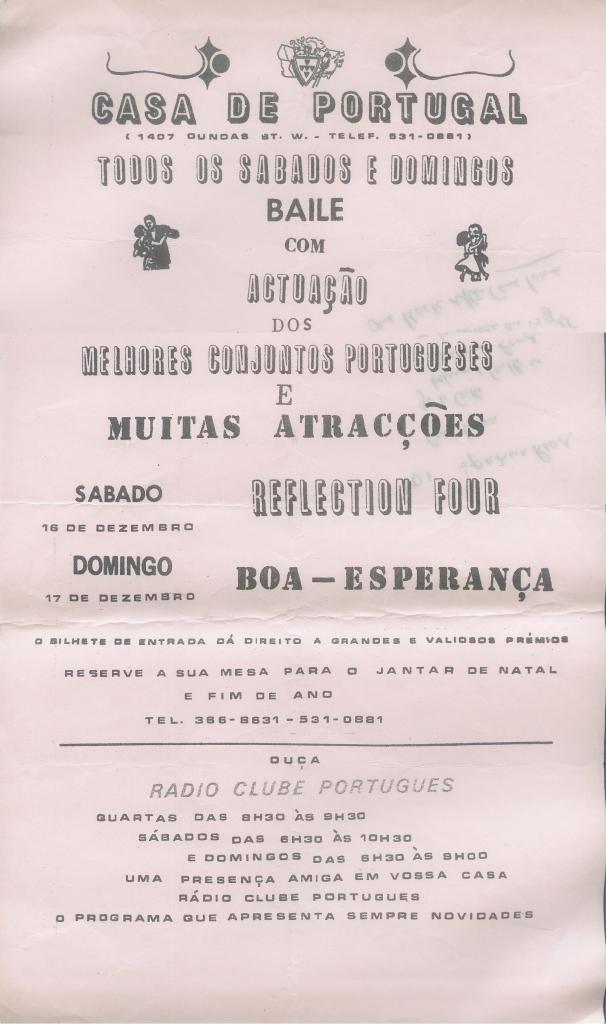
8. Poster announcing dance at Casa de Portugal on 1407 Dundas St. West. December 16-17, 197?. David Higgs fonds, 2010-018/004 (1), CTASC.
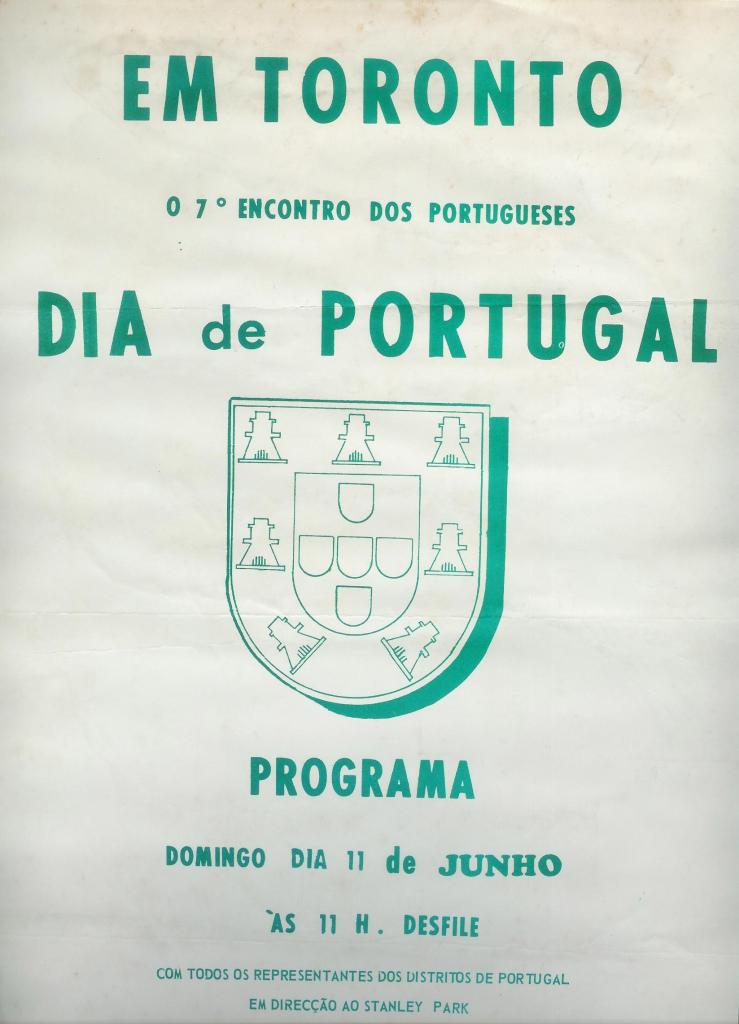
9. Poster announcing Portugal Day parade at Stanley Park, Vancouver. June 11, 197?. David Higgs fonds, 2010-018/004 (1), CTASC.
Once they started settling in large numbers in downtown Toronto, Montreal, Vancouver, and other cities, Portuguese immigrants were quick to establish businesses, parishes, clubs and associations, media outlets, marching bands, folk dance troupes, theatre groups, and other organizations that imparted a “Portuguese” character to their densely populated neighbourhoods. A multitude of social clubs representing different islands, regions, towns, or Portuguese football clubs served as spaces of community gathering offering a range of cultural activities, including sports, concerts, dances, amateur theatre shows, traditional celebrations, among others. Portuguese “national” catholic parishes were also spaces of regular social and cultural activity, including the feasts and processions associated with different regions of Portugal, some of which drew many tens of thousands of participants every year – as was the case with the Toronto’s Senhor Santo Cristo procession, which drew Azorean immigrants from across North America. Restaurants were also festive community spaces, especially those with live music and dance floors, or dining halls for weddings, baptisms, anniversaries, and other private functions.
Contrary to the deceivingly-somber mid-twentieth century Portuguese culture, as represented in Fado music, public and private merriment has been a major part of the Portuguese-Canadian experience, responsible for much of their communities’ institutional organization and cultural production. Sports (especially soccer), food, music, and dance have been at the centre of the community’s social and cultural activity.
The largest Portuguese festivities in Canada happen around the annual Portugal Day national holiday on June 10, when the various community organizations come together to celebrate themselves and their culture through parades, concerts, folk dance festivals, and other events. The first Portugal Day celebrations in Toronto were held in 1966 at the CNE coliseum. In subsequent years, Trinity-Bellwoods Park became the main site for the festival’s events, where the parade down Dundas St. West normally ends. Since 1986, the Alliance of Portuguese Clubs and Associations of Ontario (ACAPO) has organized Toronto’s program of festivities, which have grown to a month long program.
Place of origin:
Toronto, Ontario; Montreal, Québec; Vancouver, British Columbia
Date: 1973-c.1977
Archived at:
Clara Thomas Archives and Special Collections, York University Libraries
Fonds: F0571
Finding aid here