
Citations and Descriptions
1. Comunidade issue 10, vol. 1, March 3, 1976. Domingos Marques fonds, 2010-019/005 (1), Clara Thomas Archives and Special Collections (CTASC), York University Libraries.
A man wearing a crown with the word “Emigrant,” holding a lit candle with the word “Vote,” is being carried on a float by the leaders of five Portuguese political parties (PCP, MDP, CDS, PS, PPD). One leader wearing a sash with the words “Electoral funds” collects money being dropped into a basket. The subtitle reads: “After the procession we put away the saint.”
2. Cartoon, Fernanda Gaspar and Gilberto Prioste. 1979. Domingos Marques fonds, 2010-019/002 (12), CTASC.
A group of Portuguese political party leaders – Ramalho Eanes, Álvaro Cunhal, Freitas do Amaral, Mário Soares, Francisco Sá Carneiro – say to the Portuguese Prime Minister Maria de Lourdes Pintasilgo – the first and thus far only female prime minister of Portugal and second in Western Europe – “Lady of the white skirt, with a palm appearing below, put your goldfinch (pintasilgo) here fighting with my whinchat.” Pintasilgo replies: “It’s always the same talk come rain or shine. If you ask me, your problem is… too many leaves, very few grapes.” The Canaguês walks away from this scene while saying “Never mind!…”
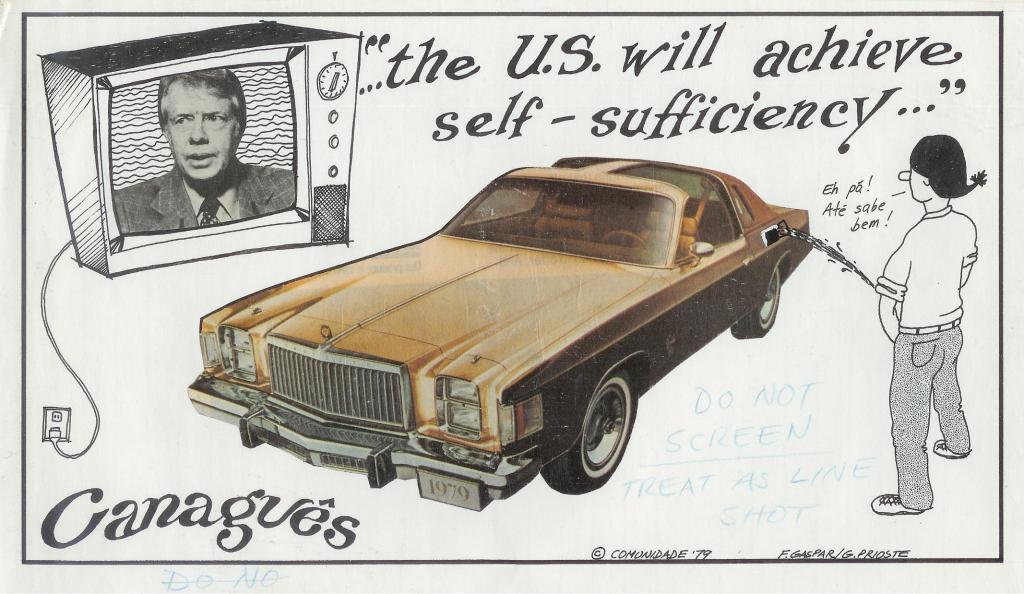
3. Cartoon, Fernanda Gaspar and Gilberto Prioste. 1979. Domingos Marques fonds, 2010-019/002 (12), CTASC.
The Canaguês urinates into the gas tank of a Chrysler automobile saying: “Hey now! This feels good!” The words “…the U.S. will achieve self-sufficiency…” float above, coming out of a television set with an image of U.S. President Jimmy Carter.
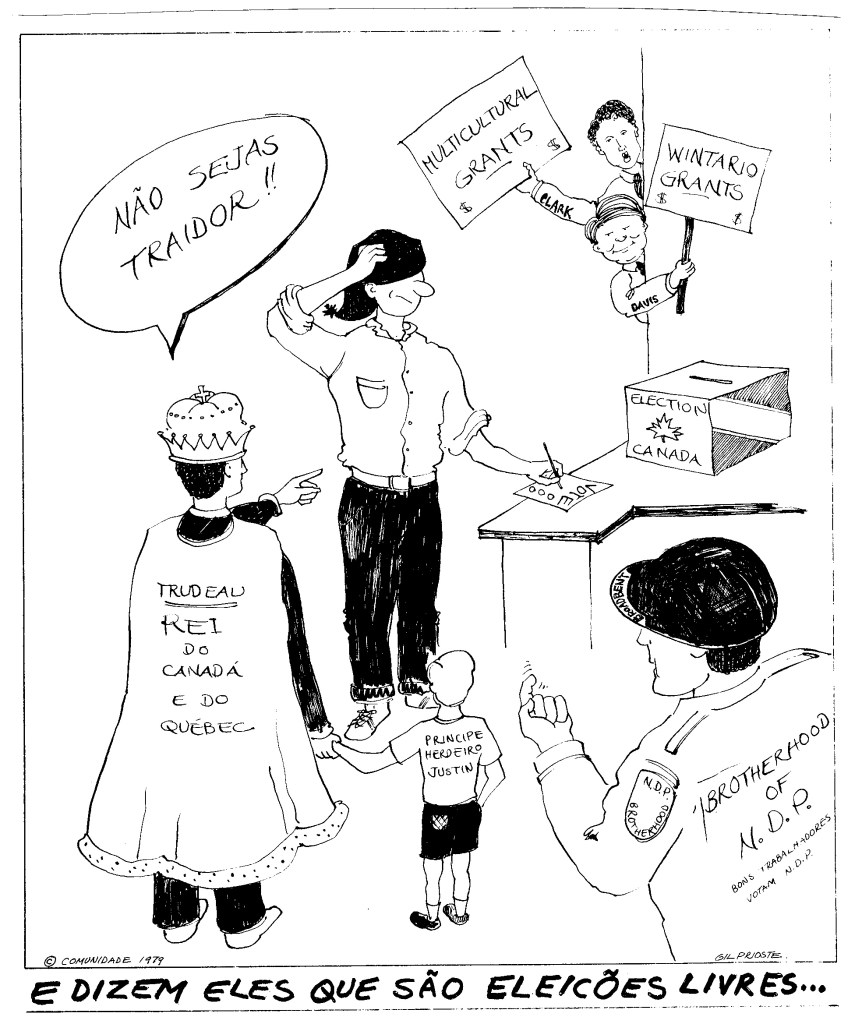
4. Cartoon, Gilberto Prioste. 1979. Domingos Marques fonds, 2010-019/002 (12), CTASC.
The Canaguês scratches his head while filling a voter’s ballot while the leaders of the Progressive Conservative, NDP, and Liberal parties are trying convince him to choose them. Joe Clark and Bill Davis wave signs saying “Multicultural grants” and “Wintario grants.” Ed Broadbent signals him with his finger to come his way. Prime Minister Pierre E. Trudeau, wearing a crown and mantle with the words “Trudeau: King of Canada and Quebéc,” holding the hand of a young Justin Trudeau wearing a shirt with the words “Prince heir Justin,” says to the Canaguês: “Don’t be a traitor!!” The subtitle reads: “And they say they are free elections…”
5. Cartoon, Gilberto Prioste. 1979. Domingos Marques fonds, 2010-019/002 (12), CTASC.
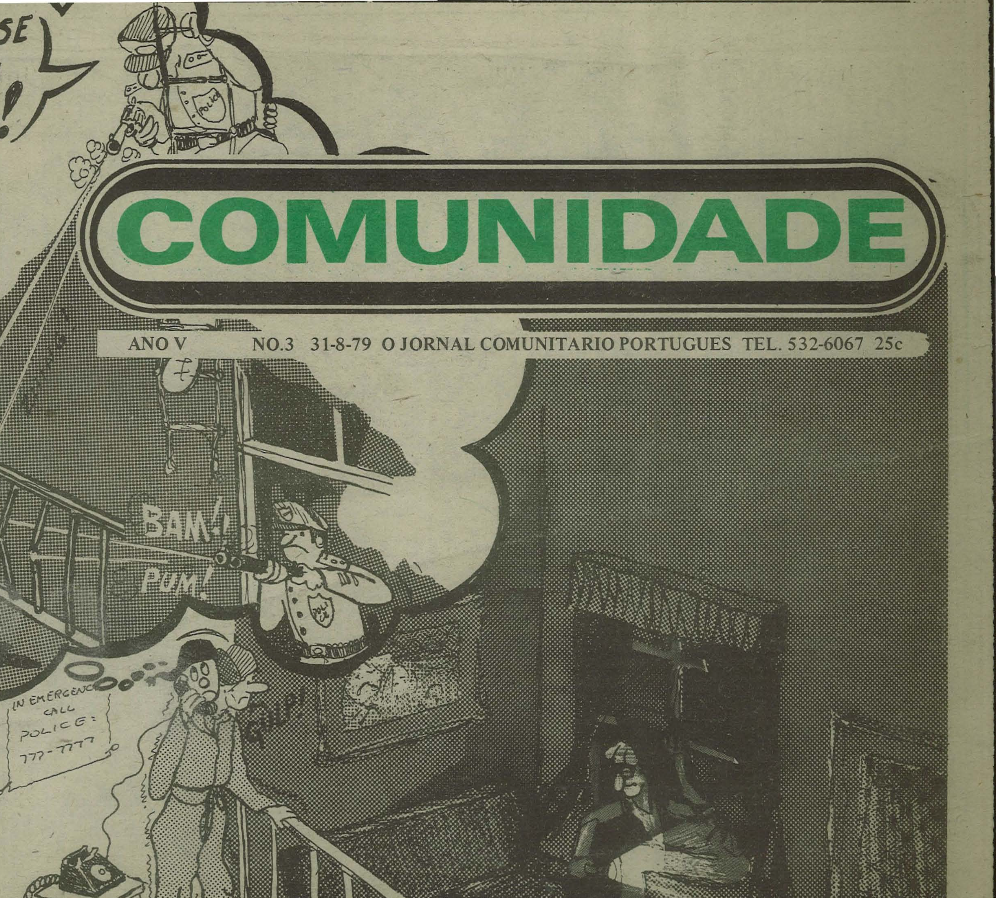
A young boy, with a horned baseball cap, a t-shirt with “5” emblazoned on it, shorts, and a devilish smile holds an oversized pen with the word “Comunidade” on one hand and flags with the words “Viva! Comunidade. Viva” and “5 Years!” in the other. Around him, a crowd of older men and women say: “Son of this and the other! Communist!! Rude!! You “potmaker”!! [an euphemism for “paneleiro,” which is slang for “faggot”) Etc… Etc…” “Now that’s good writing!!” “That’s how you talk!” “I like reading it.” “King of the ethnic newspapers!”
The newspaper Comunidade was founded in July 1975 by the Movimento Comunitário Português, a community organization based out of the Toronto’s West End YMCA, created by a group of young social workers led by João Medeiros and Domingos Marques. Comunidade was different from other Portuguese-Canadian newspapers at that time, in that most of its content was original and focused on the situation of immigrants in Canada, rather than the homeland. Although, it followed the revolutionary period in Portugal and its impacts in Toronto’s community with great interest.
Comunidade was the most progressive Portuguese-Canadian newspaper of its time. It focused on the labour organization of Portuguese workers, difficulties with integration into Canadian society, youth struggles with academic streaming and underachievement, gender equality, among other social issues. Some of the people involved in this newspaper later became community leaders in various capacities, including as NDP organizers and politicians, like Medeiros, Marques, Marcie Ponte, and Martinho Silva – see timeline of Portuguese-Canadian politicians. Their progressive stance and support for the socialist revolutionaries in Portugal drew the attention of the Canadian government’s Ethnic Press Analysis Service, which monitored the contents of newspaper and the activities of its members. According to one researcher in charge of surveilling the Portuguese-Canadian press, there was little doubt that the Comunidade’s goal was to develop “political awareness of specifically Marxist character.”
The Comunidade also featured cartoons with the “Canaguês,” a caricature of a Portuguese-Canadian immigrant man with a ribatejano toque. Created by Silva, Fernanda Gaspar, and Gilberto Prioste, they made social commentary on community affairs, Canadian and Portuguese politics.
Places of origin:
Toronto, Ontario
Date: 1975-1979
Archived at:
Clara Thomas Archives and Special Collections, York University Libraries
Fonds: F0573
Finding aid here